


Rebecca Navarro – Palo Alto Unified School District
“Sustainability is always pushing the envelope on people’s discomfort. Change is hard.”
A discarded aluminum can, tossed under a flower at the edge of a dirt road.
For Rebecca Navarro, long bike rides with her dad, picking up roadside trash and carrying it in bags balanced on handlebars, is the formative memory that has lingered throughout her career. As a child thriving in rural Connecticut – in “the part close to New York City without the glamour and lots of cows” – she learned for the first time that cans are recyclable. She also learned redemption centers paid money for them.
In typical public service fashion, Rebecca donated those coins to charity.
“My dad showed me that service to the Earth is non-negotiable. We owe everything to the natural world. To protect it, we must understand relationships and what impact each of our actions has on the broader environment. Most of our students have never physically experienced or seen the impact of their actions.”

“I don’t have the luxury of only solving a problem by looking at it with one lens. Each person’s feedback is weighed against all the other truths to find an outcome that does the most good for the most people.”
Today, relationships and actions are integral to nearly everything Rebecca does as sustainability program manager for one of the U.S.’s top K-12 public school districts, Palo Alto Unified School District (PAUSD). Based in the heart of California’s Silicon Valley and Venture Capital Row, Rebecca manages environmental health, clean energy, transportation and quite a bit of education for PAUSD’s 17 schools and more than 12,000 students each year. It is a job that Rebecca says is rarely straightforward and frequently contentious.
“Sustainability is always pushing the envelope on people’s discomfort. Change is hard. Yet a sustainable journey should not be joyless. When you help and are successful, that’s where we make meaningful change.”
Energy, for example, is a tricky thing, says Rebecca. Electricity is not tangible. Unlike watching ice melt, it is hard to see what renewable energy can be replacing.
What people can see is buildings. Landscaping. The way things have been for years.
In the case of PAUSD, when it became known that the best place to locate solar generation – a keystone component of the district’s sustainability and city of Palo Alto’s climate action plans – was to build highly desired solar parking shade structures in front of a beloved high school, a landmark about to celebrate its centennial, tensions built quickly.
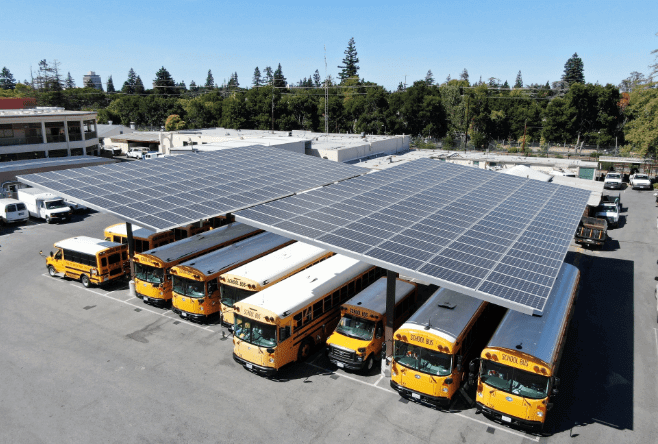
solar parking array was re-located to a bus yard versus a historic high school.
“The more you can do now that is genuine in relationships, the more likely that when you get to the other side of a big, contentious project, you will still be on the same team at the end of it.”
“I don’t have the luxury of only solving a problem by looking at it with one lens. Each person’s feedback is weighed against all the other truths to find an outcome that does the most good for the most people.”
The process was initially heated – and political. The solution became collaborative – and lasting.
Working closely with a pivotal community leader who had once been the solar project’s biggest detractor, Rebecca and community teams worked together to successfully find and relocate the 100-kW solar array to another school location. From those rough beginnings, the two leaders have since worked together to accelerate other solar installations across six school campuses.
“Having authentic relationships is as important – or even more so – as doing the work. The more you can do now that is genuine in relationships, the more likely that when you get to the other side of a big, contentious project, you will still be on the same team at the end of it.”
Leading by example is also crucial, says Rebecca.
When she first joined PAUSD in 2005 she taught eighth grade English. Rebecca says that shifting to become the district’s energy manager was more of a calling than a job. A self-described “one-woman-energy-conservation-show” meant lots of walking. For years, visiting hundreds of classrooms, changing thermostat set points, climbing up and down from roofs, calming angry staff disgruntled by overly sensitive lighting controls, she has become a highly visible face of calm answers and changes that frequently push the limits of people’s comfort zones.

“What is fun is meeting students where they are. There is a lot of learning underway and to see that spark ignite with students, to see them get out of their routine and into new ways, to watch them learn something new for the first time.”
“People are smart, and even if you lead by example or frame change as nonjudgmental, people will feel what they want to feel and that’s absolutely OK.”
At home, she lives with her husband, Sergio, and three children, all within an 800-square-foot house. To literally minimize their carbon footprint, they remodeled rather than rebuild larger to take advantage of the smaller space and the great California climate. Rebecca says her family has also gone through their own huge culture shift to achieve as close to zero waste as possible. Today, the entire household produces only a gallon of trash every six months. Everything else is reused, recycled, or composted.
In the end, Rebecca’s ultimate wish is that her efforts help her own children as well as future generations make wise decisions – and find some joy doing it along the way.
“What is fun is meeting students where they are. There is a lot of learning underway and to see that spark ignite with students, to see them get out of their routine and into new ways, to watch them learn something new for the first time. That’s why I do this. I’m confident students have what they need to grow up to be good stewards of the natural world.”
Additional Resources:
Reaching ESG goals with renewables
ESG isn’t just a fleeting fad or a buzzword. It’s been around for more than 20 years and has the potential to have a significant impact on the brand, financial metrics and outlook of organizations.
That makes it less of a good public relations story and more critical to the long-term success of your business.
In short? To help promote a stronger corporate brand and long-term growth, now is the time to take a proactive approach to integrating ESG strategies into your overall business model.
And we know just how to get you started.
In this guide to renewables and achieving ESG goals for businesses, we’ll help you better understand what it means for businesses and how you can leverage it to make smarter investments in renewables that position your organization for long-term success.
What is ESG?
A growing number of institutional and individual investors are evaluating their investments with companies, taking measured steps to align themselves with organizations whose values reflect their own.
In recent years, public awareness and support for social and environmental issues have gained steam — and investors want to know how companies are navigating climate change, thinking about jobs for tomorrow, managing company culture, etc.
Enter ESG investing.
Environmental, social and governance (ESG) investing is a megatrend in the investment world.
It’s a three-pillar system that evaluates:
- Environmental – This measures a company’s ecological and environmental commitment to its community. It may include energy efficiency plans, plans to incorporate carbon-free renewables into its energy mix, climate change mitigation, natural resource and habit conservation initiatives, supply chain and environment initiatives, etc.
- Social – This measures how a company manages relationships with employees, suppliers, customers and the communities where it operates. This includes whether a company works with other suppliers who share the same values, how it invests and gives back to local communities, commitments to diversity, equity and inclusion, etc.
- Governance – This examines a company’s policies, goals and how leadership, executive pay, audits, internal controls and shareholder rights operate. Governance also covers conflicts of interest, political contributions for favorable treatment, etc.
If you think ESG investing trends are for a small or relatively niche market, guess again. Despite the onset of a global pandemic, sustainable funds attracted a record $51.1 billion in net flows in 2020 – more than twice the previous record set in 2019.
Millennial and Generation X investors are reportedly set to inherit an estimated $30 trillion in wealth in the coming years, with a Morgan Stanley study suggesting this group is also twice as likely to invest in companies and funds that align with their environmental and social values.
And with global policy leaders pushing to dramatically reduce emissions, lower resource usage and pull greenhouse gases from the atmosphere, interest in sustainability is only expected to continue to grow – not only among investors but also among businesses.
Why are ESG initiatives important for my business?
So, we know why the growing popularity of ESG investing is important to investors.
But how exactly does ESG investing impact businesses like yours?
Consider a more positive brand reputation for your company. Reduced business risks or mitigated negative outcomes, thanks to a greater emphasis on corporate environmental, social responsibility and corporate governance. And improved long-term financial performance across several metrics, courtesy of a growing body of research in recent years.
An NYU Stern Center for Sustainable Business and Rockefeller Asset Management analysis of 1,000-plus research papers examined the relationship between ESG and financial performance from 2015 to 2020. It found that not only did sustainability initiatives appear to drive better financial performance for companies, due to mediating factors including improved risk management and more innovation, higher operational efficiency and others.
Want to know additional ways a focus on ESG values helps position organizations for success?
A NASDAQ article suggests robust ESG initiatives can also help organizations:
- Adapt to changing socioeconomic and environmental conditions by better positioning themselves to identify strategic opportunities and meet competitive challenges. By taking steps on issues such as sustainable environmental policies, these companies strengthen their brand.
- Attract more value-based investors who understand that change takes time and are more interested in building long-term value over a multiyear period than flipping stock in the near term.
- Attract and retain employees who are passionate about the organization and have a vested interest in strengthening the company’s brand.
So, ESG initiatives can be a win-win for your organization – and incorporating renewables into your energy mix can be just the right solution to better reach your ESG goals.
Finding ESG opportunities in renewables and net-zero emissions goals
Setting and achieving net-zero emissions goals is just one way a growing number of companies are folding more environmentally conscious goals into their overall business strategy, making them more desirable to socially conscious investors.
Through financing options like power purchase agreements, companies are finding it easier and more affordable to leverage renewables and achieve sustainability goals.
Let’s take a closer look at additional organizations whose commitments to cleaner energy have allowed them to make a broader impact on mitigating climate change, helping underserved communities and more:
Environmental Leadership
- In 2020, George Washington University committed to accelerate its carbon neutrality timeline to at least 2030. The university has an ambitious goal to divest 100% from fossil fuel investments and remove all greenhouse gas emissions produced since its founding in 1821. It invested in large-scale solar generation near its Washington, D.C., campus – a move that helped to immediately cut its carbon footprint by 20% and inspired other universities to expand their renewables investments.
Social Impact
- Kroger sought to cut energy spending at the La Habra Bakery and find more ways to deliver on its Zero Hunger | Zero Waste social impact plan. Leveraging emissions-free renewable energy was crucial to Kroger spending less on electric bills and putting more investment into communities. A rooftop solar project that consisted of nearly 3,000 solar panels on the bakery’s 300,000-square-foot rooftop reduced 1,420 metric tons of emissions, equivalent to powering 240 homes annually.
As you can see, these organizations (and so many more!) are leading the way in reducing their emissions and achieving real, measured sustainability goals through affordable and innovative financing and operating solutions. Their commitment to sustainability isn’t an afterthought; it’s part of their overall business practice.
Start your ESG journey
Ready to start leveraging renewables and sustainable energy and become an environmental sustainability leader?
Here’s the good news: Transitioning to renewables and reaching sustainability goals doesn’t have to be difficult.
Contact us today, and we’ll explore solutions and options designed to help you reach your net-zero and ESG goals.